
Insulation Payback: How Fast Does Cellulose Pay for Itself?

Insulation Payback: How Fast Does Cellulose Pay for Itself in Ontario?

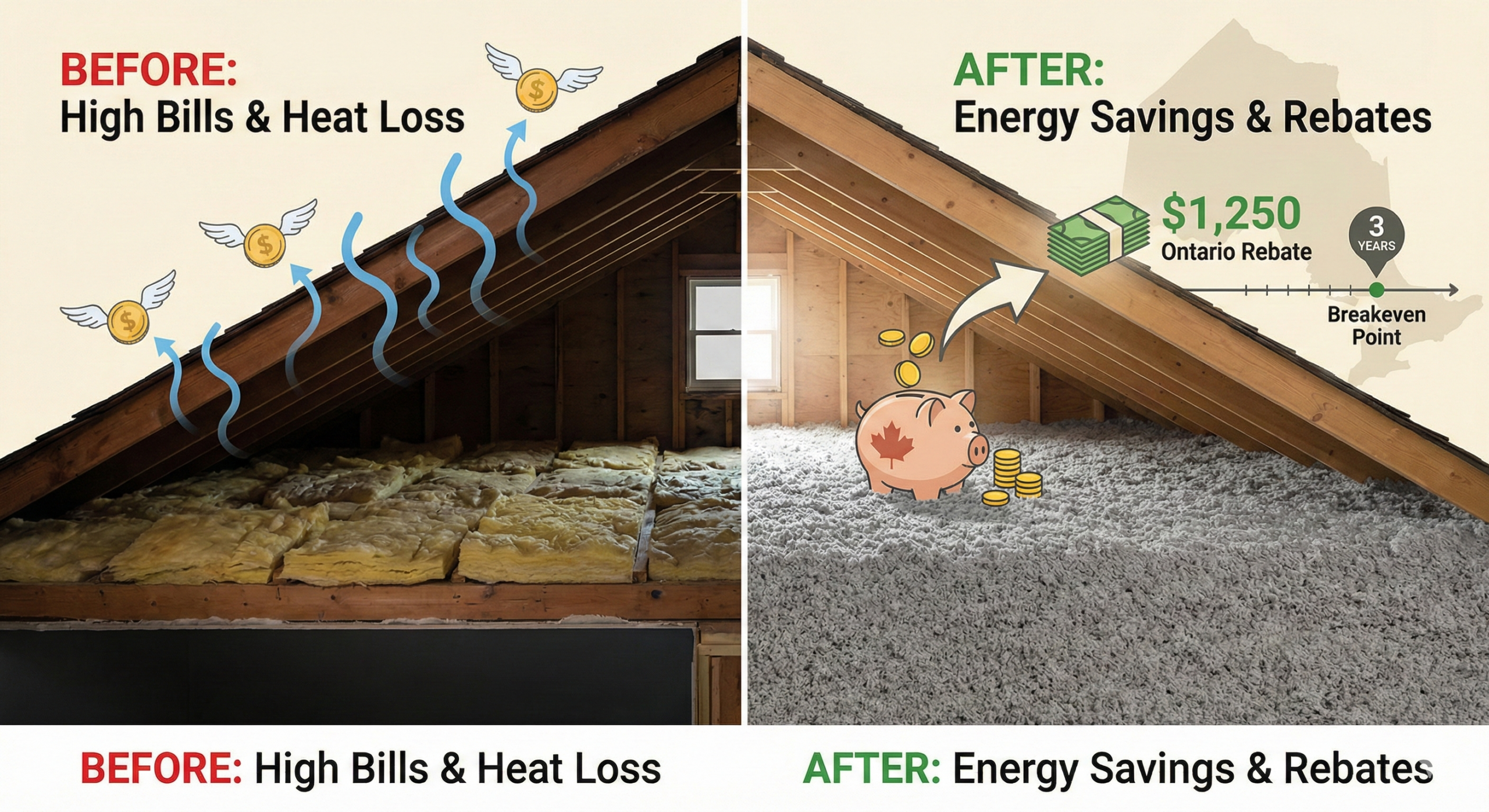
When you spend money on a kitchen renovation, you get beautiful countertops. When you spend money on a new bathroom, you get a spa-like shower. But when you spend money on attic insulation, you get something even better: your money back.

Attic insulation is unique among home improvements because it is a financial investment with a measurable return. In a climate like Southern Ontario’s—with freezing winters and humid summers—your attic is the primary battlefield for energy loss.

At Therm-O-Comfort, homeowners often ask us: “Is it really worth upgrading?” Today, we are crunching the numbers to show you how quickly Therm-O-Light cellulose insulation pays for itself.

The Scenario: A Typical Ontario Home

Every home is unique, but to calculate payback, we need a representative scenario. Let’s look at a common situation we see in areas like St. Thomas, London, and Strathroy:

  • The Home: A 1,500 sq. ft. bungalow built in the 1980s.
  • Current Insulation: Roughly R-20 (about 6 inches of old, settled fiberglass).
  • The Problem: Heat escapes rapidly in winter, and the second floor is unbearably hot in summer.
  • The Goal: Upgrade to R-60 using blown-in cellulose to meet current building code recommendations.

The Investment vs. The Savings

According to Natural Resources Canada, upgrading an attic from R-20 to R-60 in our climate zone can significantly reduce heat loss. For many homes, this translates to reducing heating and cooling costs by approximately 15% to 25%.

With Ontario electricity and gas rates remaining high in 2026, let’s assume this home spends roughly $2,400 annually on heating and cooling.

A conservative 20% savings equals $480 back in your pocket every single year.

The Math (With the 2026 Rebate)

This is where the new 2026 attic rebates radically change the equation. Because you no longer need an energy audit, the upfront cost is lower, and the rebate is accessible.

The Payback Calculation:

  • Estimated Project Cost (R-20 to R-60): ~$2,800
  • Less: Enbridge/IESO Rebate: -$1,250
  • Your ACTUAL Net Cost: $1,550
  • Annual Energy Savings: ~$480 / year

$1,550 (Cost) ÷ $480 (Savings/Yr) = 3.2 Years to Break Even.

After just over three years, your insulation is paid for. Every year after that, that $480 is pure profit compared to not having done the upgrade.

(Compare that to the payback period of new windows, which is often 15-20 years, or solar panels, which can be 8-12 years).

Why Cellulose Maximizes Your ROI

Why do we use cellulose for these residential retrofit projects instead of fiberglass batts or spray foam? It comes down to cost-effectiveness.

  1. The Gap-Filler: Attic joists are rarely perfectly spaced, and there are wires and pot lights to navigate. Fiberglass batts leave gaps. Blown-in cellulose flows around obstacles like a liquid, creating a seamless thermal blanket.
  2. Cost Per R-Value: Cellulose provides a high R-value per inch at a lower material cost than spray foam, making it the “sweet spot” for attic retrofits.
  3. Longevity: Our Therm-O-Light product is treated with borates. Read about our manufacturing process here to see how this treatment protects your investment against pests and mold, ensuring the insulation lasts as long as the house.

The “Invisible” Returns: Carbon & Comfort

The financial math is compelling, but it doesn’t account for the immediate improvement in quality of life or the environmental impact.

  • Comfort: No more needing an extra sweater just to sit in the living room.
  • Quiet: The Cellulose Insulation Manufacturers Association highlights that the density of cellulose makes it excellent at dampening exterior road noise.
  • Roof Protection: Proper insulation helps prevent ice dams, saving you from costly roof repairs down the road.

Stop Paying the Utility Companies More Than You Have To

With energy prices where they are in 2026, an uninsulated attic is a luxury most Ontarians can’t afford. The combination of high annual savings and the current Save on Energy incentives makes this the smartest financial decision you can make for your home.

Don’t let another season of high bills go by. Contact Therm-O-Comfort today to find a certified installer in your area and get an accurate quote for your home.


Disclaimer: The calculations above are estimates based on typical Ontario home averages and 2026 program rules. Actual costs, savings, and payback periods will vary depending on your home’s size, current insulation levels, local energy rates, and thermostat habits.
The 2026 Ontario Attic Rebate: How to Get $1,250 Back Without an Energy Audit

If you have been waiting for the “perfect time” to upgrade your attic insulation, 2026 is officially the year.

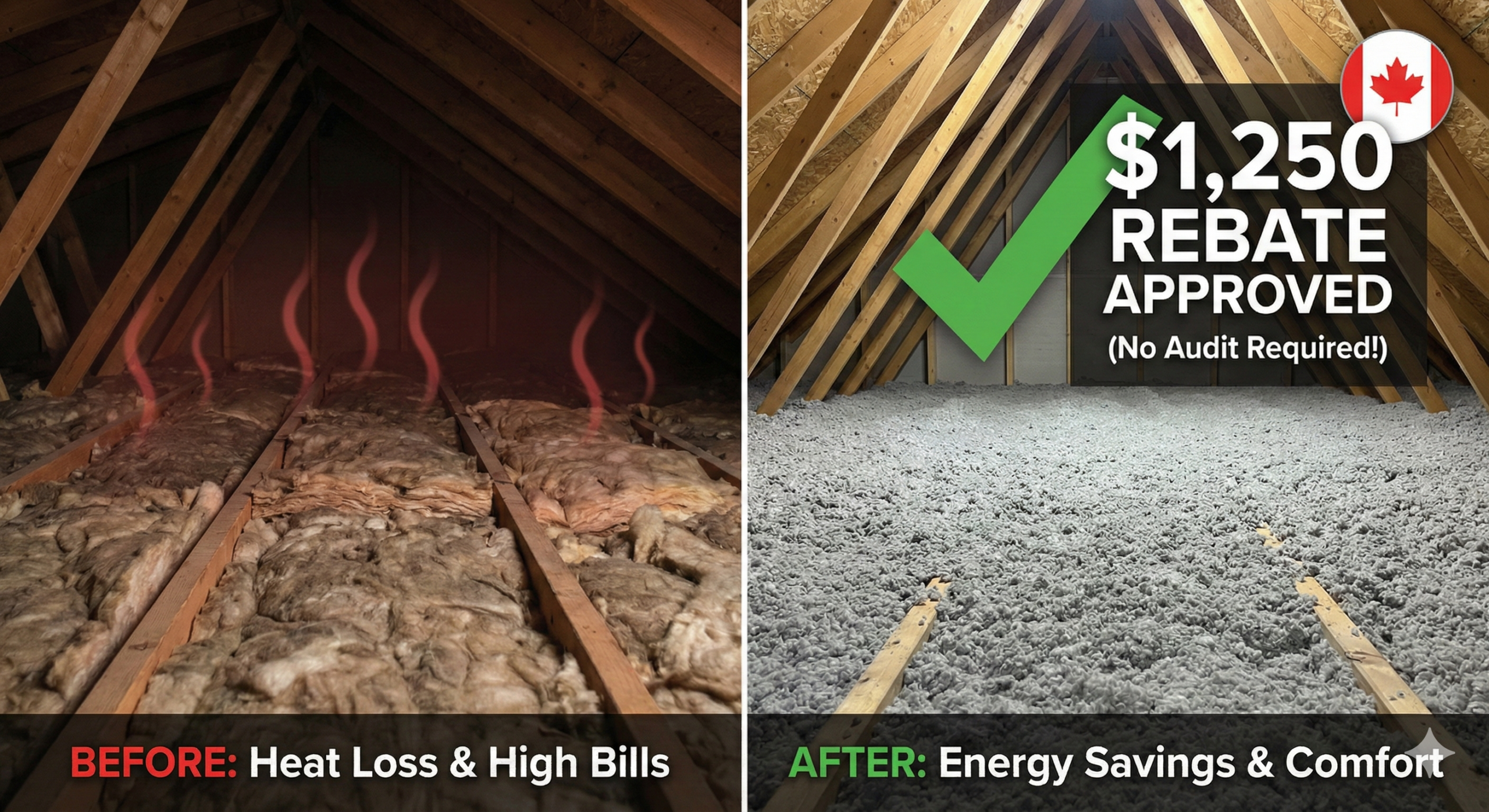
For years, accessing government rebates meant paying hundreds of dollars upfront for a home energy audit before you could even touch a bag of insulation. That hurdle is gone. Under the newly updated Home Renovation Savings Program (partnership between Enbridge Gas and Save on Energy), Ontario homeowners can now receive up to $1,250 in rebates for topping up their attic—completely audit-free.

At Therm-O-Comfort, we want to ensure you don’t leave this money on the table. Here is everything you need to know about the 2026 rules, the deadline, and how to maximize your ROI.

Split screen showing an uninsulated attic with heat loss vs a Therm-O-Comfort insulated attic with blown-in cellulose.

The Big Change: Higher Rebates, Less Paperwork

As of January 2026, the rebate maximum for the “standalone attic stream” increased from $1,000 to $1,250. This stream is designed for homeowners who want to do a single, high-impact upgrade without renovating their entire house.

The best part? No pre-work or post-work energy assessment is required. This saves you roughly $600 in audit fees and weeks of scheduling delays. You simply hire a participating contractor, have the insulation installed, and submit the proof.

How Much Can You Get?

The rebate amount depends on your attic’s current insulation level. The program is designed to target homes that are losing the most heat.

  • Tier 1 (The Big Saver): If you have R-12 or less (roughly 3-4 inches of old insulation) and you upgrade to R-50, you qualify for the maximum $1,250 rebate.
  • Tier 2: If you have between R-13 and R-25 and upgrade to R-50, you qualify for $1,000.
  • Tier 3: If you have between R-26 and R-35 and upgrade to R-50, you qualify for $800.

Note: Rebates are capped at 50% of the total project cost.

Am I Eligible?

To qualify for this specific stream, you must meet a few basic criteria set by Enbridge Gas and the IESO:

  1. Heating Source: You must be an Enbridge Gas customer heating with natural gas, OR an Ontario resident heating with electricity, oil, propane, or wood.
  2. Home Type: The home must be a detached, semi-detached, or row townhome.
  3. The Installer: You must use a “Participating Contractor.” (DIY installations do not qualify for this specific rebate).

Why Cellulose is the “Secret Weapon” for this Upgrade

To hit that R-50 target, you need a material that fills every gap, void, and odd corner of your attic. This is where Therm-O-Comfort’s loose-fill cellulose outperforms traditional batts.

Because our insulation is blown in, it forms a seamless blanket over your existing insulation (regardless of whether you currently have fiberglass, rock wool, or wood chips). It creates a custom fit around pot lights, plumbing stacks, and trusses, stopping the air leakage that steals your heat.

Pro Tip: Beyond the heat savings, our borate-treated cellulose provides a passive barrier against pests—a common attic nuisance in Ontario. Learn more about our manufacturing process here.

Important Deadline: November 30, 2026

While the program has been extended, the current funding window is set to expire on November 30, 2026. However, we strongly advise against waiting until the fall.

Every year, we see a “rush to the finish” in October and November. Contractors get booked up, and administrative processing times slow down. By booking your attic top-up in the Spring or Summer, you secure your spot and start saving on your air conditioning bills immediately.

How to Apply

  1. Check Your Attic: Pop your head up the hatch. If you can see the floor joists, you likely have less than R-25 and are a prime candidate for the full rebate.
  2. Find a Contractor: You need a professional installer to ensure the work meets the Save on Energy safety standards (ensuring baffles are installed for soffit ventilation).
  3. Install & Save: Once the work is done, your contractor typically handles the rebate submission for you. You receive the cheque in the mail roughly 8-12 weeks later.

Ready to Stop Heating the Neighbourhood?

Adding insulation to your attic is widely considered the #1 return on investment for home energy upgrades. With the government covering up to $1,250 of the cost, the payback period is faster than ever.

If you need help finding a certified installer in St. Thomas, London, or the surrounding area who uses high-quality Therm-O-Comfort products, we can help point you in the right direction.

Contact Us Today


Disclaimer: Rebate amounts and program terms are subject to change by Enbridge Gas and the IESO. Information is current as of January 2026. Please verify the latest eligibility on the official program website.